Syllogisms: how to tell what must be true
"All roses are flowers. Some flowers fade quickly." Do some roses fade quickly? A clear method for logical reasoning questions, and the five traps that catch almost everyone.
"All roses are flowers. Some flowers fade quickly. Therefore, some roses fade quickly."
Does that conclusion follow? Most people say yes. It sounds reasonable, and it may even be true of real roses. But it doesn't follow from those two sentences, and seeing why is the key to a whole family of logical reasoning questions.
These are called syllogisms: two (sometimes three) statements, called premises, and a conclusion you have to judge. They turn up in aptitude tests, entrance exams and reasoning assessments because they test something useful: whether you can tell what a set of facts actually guarantees, as opposed to what seems likely. That skill matters well beyond tests. It's the difference between reading a report carefully and reading what you expected to find in it.
The one rule that matters most
A conclusion follows only if it must be true whenever the premises are true. Not "probably". Not "usually". Must.
That gives you a powerful way to test any conclusion. Instead of asking "is this true?", ask: can I imagine a world where the premises are true and the conclusion is false? If you can find even one, the conclusion doesn't follow.
Try it on the roses. Imagine a world where every rose is a flower, some flowers (say, poppies) fade quickly, and every rose lasts for weeks. Both premises are true; the conclusion is false. So it doesn't follow.
Four kinds of statement
Almost every syllogism is built from four types of sentence:
- All A are B. "All doctors are teachers."
- No A are B. "No reptiles are mammals."
- Some A are B. "Some pilots are chefs."
- Some A are not B. "Some pilots are not chefs."
Two details about these trip people up again and again:
- "Some" means at least one, and possibly all. "Some pilots are chefs" doesn't tell you that some pilots aren't chefs. In logic, it's still true if every pilot is a chef.
- "All A are B" doesn't promise that any A exist. "All unicorns are horses" can be true in a world with no unicorns. That's why, in strict logic, "All A are B" doesn't let you conclude "Some A are B". BrainTally's Syllogism game follows this rule.
Draw it
When a syllogism is tangled, draw circles. One circle for each group, overlapping where the groups share members. "All doctors are teachers" is a doctors circle drawn entirely inside a teachers circle. "No reptiles are mammals" is two circles that don't touch. "Some" means the circles overlap, and you mark the overlap to show something is definitely there.
Then try to draw the circles in a way that makes the conclusion false. If you can, the conclusion isn't guaranteed. If every possible drawing makes it true, it is.
Five traps, and how to spot them
1. Believing the conclusion because it's true
Psychologists call this belief bias, and it's been studied for decades: people are far more likely to accept an invalid argument when its conclusion matches what they already believe, and to reject a valid one when its conclusion sounds absurd. The fix is to swap in letters. "All A are flowers. Some flowers are B. So some A are B." Stripped of roses, the gap is easier to see.
The opposite holds too. "All fish can fly. All salmon are fish. So all salmon can fly." The first premise is false in real life, but the argument is perfectly valid: if the premises were true, the conclusion would have to be. Tests ask about the logic, not the facts.
2. Turning "all" around
"All doctors are teachers" does not mean "All teachers are doctors". The doctors circle sits inside the teachers circle, and there can be plenty of teachers outside it.
Some statements can be turned around safely: "No A are B" means the same as "No B are A", and "Some A are B" means the same as "Some B are A". But "All A are B" and "Some A are not B" can't be reversed.
3. The shared middle that doesn't connect
"All cats are mammals. All dogs are mammals." Does anything follow about cats and dogs? No. Both groups sit inside the mammals circle, but that tells you nothing about how they relate to each other. When the group that links the two premises is only mentioned in an "all … are [it]" or "some" way, the link is often too weak to carry a conclusion. The roses example fails for exactly this reason: knowing that roses are among the flowers, and that some flowers fade quickly, doesn't tell you whether those fast-fading flowers include any roses.
4. Two "somes"
"Some students are athletes. Some athletes are musicians." Nothing follows about students and musicians. The athletes who are students and the athletes who are musicians could be completely different people. Two "some" premises never guarantee a conclusion.
5. Two negatives
"No poets are accountants. No accountants are surfers." Nothing follows about poets and surfers. Knowing what two groups are not doesn't connect them to each other. Two negative premises never guarantee a conclusion.
Worked examples
Try each before reading the answer.
1. All doctors are teachers. All teachers are runners. Therefore, all doctors are runners.
Follows. The doctors circle is inside teachers, which is inside runners. There's no way to draw it otherwise.
2. No reptiles are mammals. Some pets are reptiles. Therefore, some pets are not mammals.
Follows. The pets that are reptiles can't be mammals, and the second premise says there's at least one.
3. All poets are dreamers. Some dreamers are bakers. Therefore, some poets are bakers.
Doesn't follow. The dreamers who bake could all be outside the poets circle.
4. Some pilots are not chefs. All chefs are artists. Therefore, some pilots are not artists.
Doesn't follow. The pilots who aren't chefs might still be artists for some other reason.
5. All squares are rectangles. No rectangles are circles. Therefore, no squares are circles.
Follows. Squares sit inside rectangles, and rectangles share nothing with circles, so squares can't either.
A quick checklist
- Ignore whether the statements are true in real life.
- Read "some" as "at least one, maybe all".
- Don't turn "All A are B" around.
- Two "somes" or two negatives? Nothing follows.
- Try to imagine, or draw, a world where the premises hold and the conclusion fails. If you can, reject it.
Practise it
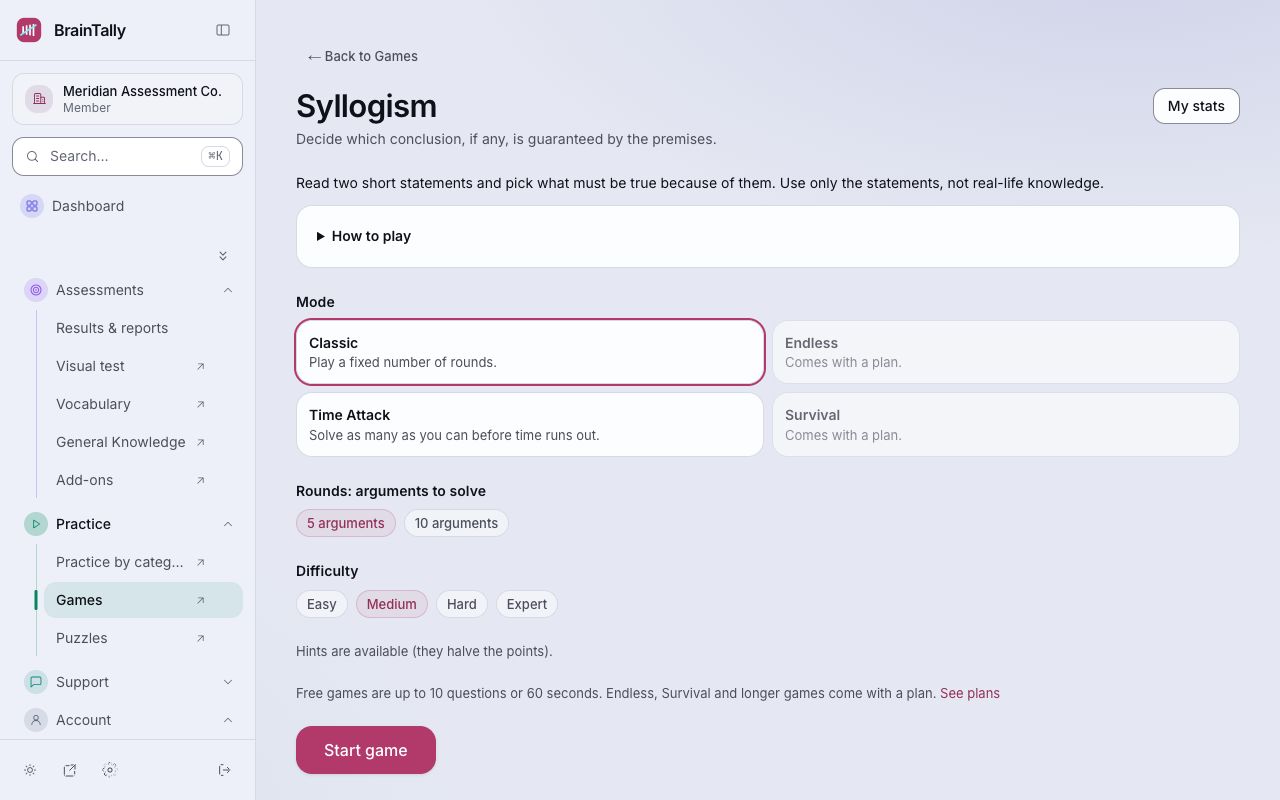
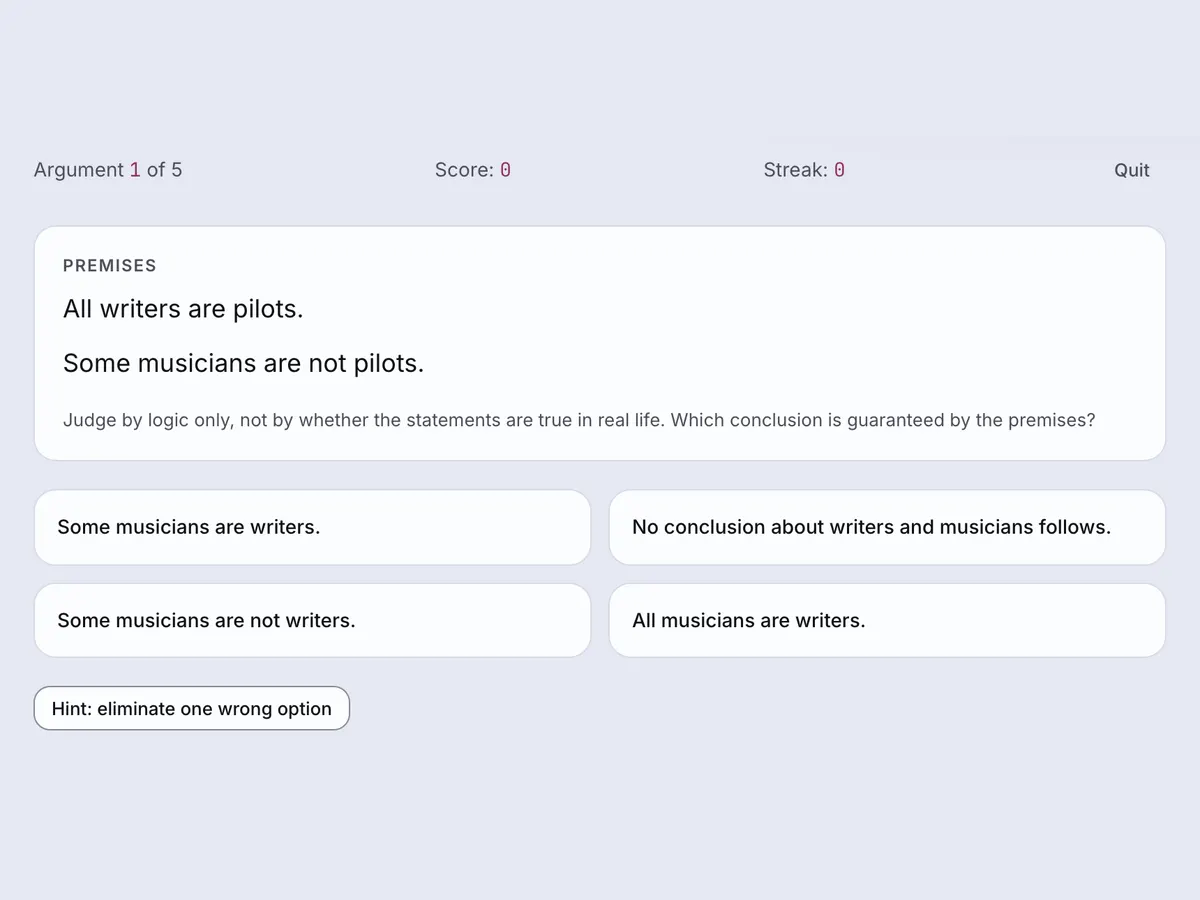
Syllogisms reward practice more than almost any other question type, because the traps are always the same few. In BrainTally's Syllogism game, every answer comes with an explanation that shows a possible world where the premises hold but a wrong conclusion fails, which is exactly the habit this post is about. On Expert, arguments grow to three premises with a two-minute clock.
If you enjoy these, try Deduce next: the same kind of careful reasoning, applied to working out who sits where from a list of clues.