Number sequences: the eight patterns behind almost every puzzle
Number sequences feel like they need a flash of insight, but most are built from a small family of patterns. Here's the order to check them in, with examples.
"2, 6, 12, 20, 30, ?" Number sequences are one of the oldest puzzle types in reasoning tests, and one of the most learnable. They feel like they need a flash of insight, but most of them are built from a small family of patterns. Learn to test for those patterns in a sensible order and you'll solve the majority in under a minute.
Here's the order we'd check them in, with an example of each.
1. A constant difference
Subtract each number from the next. If the gaps are all the same, you're done.
3, 7, 11, 15, ? The gap is always 4, so the next number is 19.
This is always the first check, because it takes seconds and it rules a lot out.
2. Differences that follow their own pattern
If the gaps aren't constant, write them down underneath and look at them as a sequence.
2, 6, 12, 20, 30, ? The gaps are 4, 6, 8, 10. They go up by 2, so the next gap is 12 and the answer is 42.
This "differences of differences" step is the single most useful trick in this whole post. A surprising number of hard-looking sequences become easy once you write one row of gaps beneath them.
3. A constant ratio
If the numbers grow quickly, divide instead of subtract.
3, 6, 12, 24, ? Each number doubles, so the next is 48.
81, 27, 9, 3, ? Each number is divided by 3, so the next is 1.
4. Squares, cubes and their neighbours
Some numbers should ring a bell on their own: 1, 4, 9, 16, 25, 36 (squares) and 1, 8, 27, 64, 125 (cubes). Puzzles often use them directly or nudge them by one.
2, 5, 10, 17, 26, ? These are the squares plus one (1+1, 4+1, 9+1…), so the next is 36 + 1 = 37. You can also spot it with the differences trick: 3, 5, 7, 9, so the next gap is 11.
5. Prime numbers
2, 3, 5, 7, 11, 13, 17, 19, 23, 29. If a sequence jumps irregularly and none of the above fits, check whether it's the primes, or something built from them.
2, 3, 5, 7, 11, ? The next prime is 13.
6. Each number from the two before it
In the Fibonacci sequence, each number is the sum of the two before it: 1, 1, 2, 3, 5, 8, 13. Puzzles use the same idea with different starting numbers, or with a different operation.
4, 5, 9, 14, 23, ? 4 + 5 = 9, 5 + 9 = 14, 9 + 14 = 23, so the next is 14 + 23 = 37.
A clue that you're looking at one of these: the numbers grow faster than a constant difference but more slowly than doubling.
7. Two sequences woven together
If a sequence looks chaotic, try reading every second number.
1, 10, 2, 20, 3, 30, ? Read the odd positions: 1, 2, 3. The even positions: 10, 20, 30. The next number continues the first strand, so it's 4.
8. Mixed operations
Finally, some sequences alternate between operations, such as "×2, then +1".
3, 6, 7, 14, 15, ? ×2, +1, ×2, +1… so the next step is ×2 and the answer is 30.
A checking order that works
When a new sequence appears, run down this list:
- Constant difference?
- If not, write the differences. Do they make a pattern?
- Growing fast? Try a ratio.
- Recognise squares, cubes or primes?
- Each number from the two before it?
- Looks chaotic? Read every second number.
- Still nothing? Look for alternating operations.
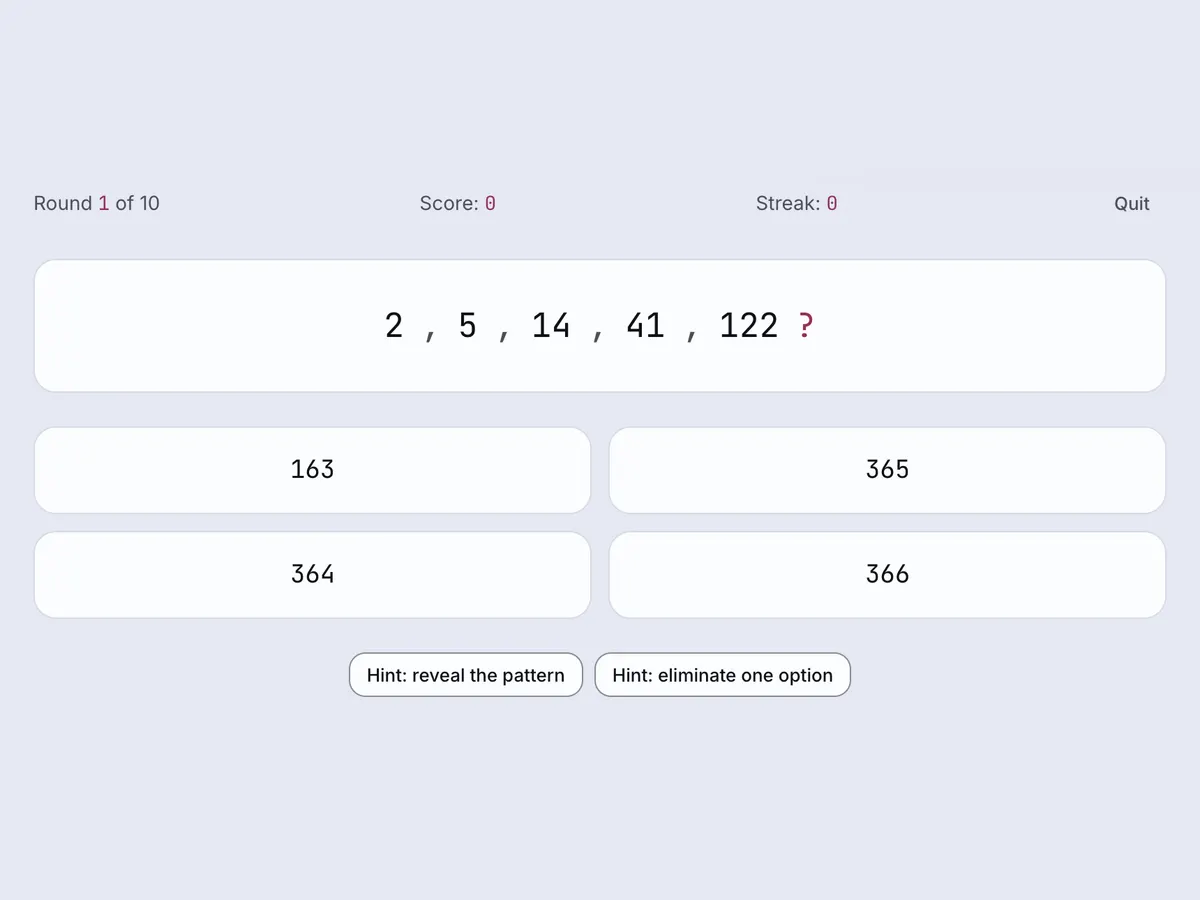
On a multiple-choice test you have one more tool: the options. If you've narrowed it to "it's probably squares plus something", the options will often settle it. Just don't start from the options. Work out what you think the answer is first, so a tempting wrong option can't lead you.
Practise with explanations
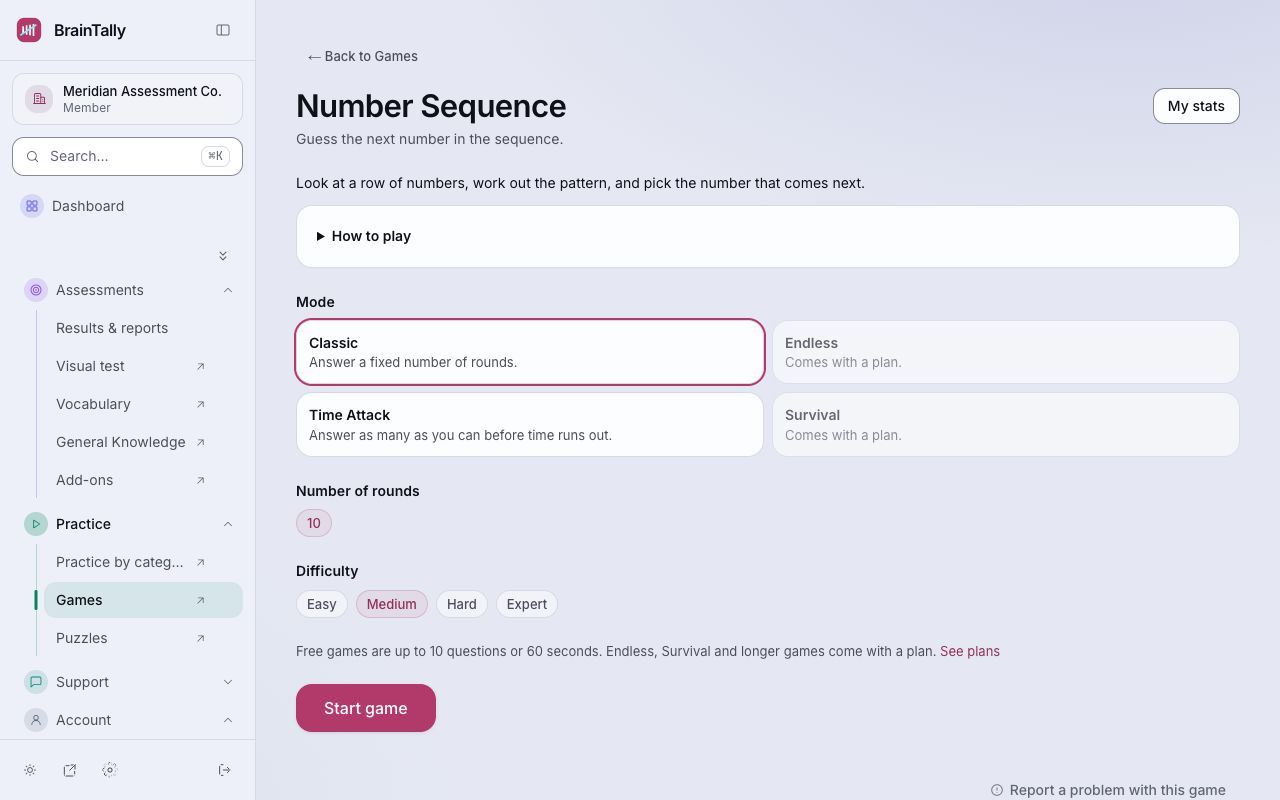
Patterns only become automatic with repetition, and repetition only helps if you learn from the misses. In BrainTally's Number Sequence game, after every answer you can press "Why was I wrong?" to see the rule, the working, and why the wrong answer looked tempting. Harder levels introduce families like quadratics, Lucas numbers and Catalan numbers, once the basics feel easy.
And the sequence at the top of this post? 2, 6, 12, 20, 30. The gaps are 4, 6, 8, 10, so the next is 42.