How to solve matrix puzzles: one property at a time
Matrix puzzles look intimidating, but almost all of them give way to one habit. The method, the rules that come up again and again, and the traps to avoid.
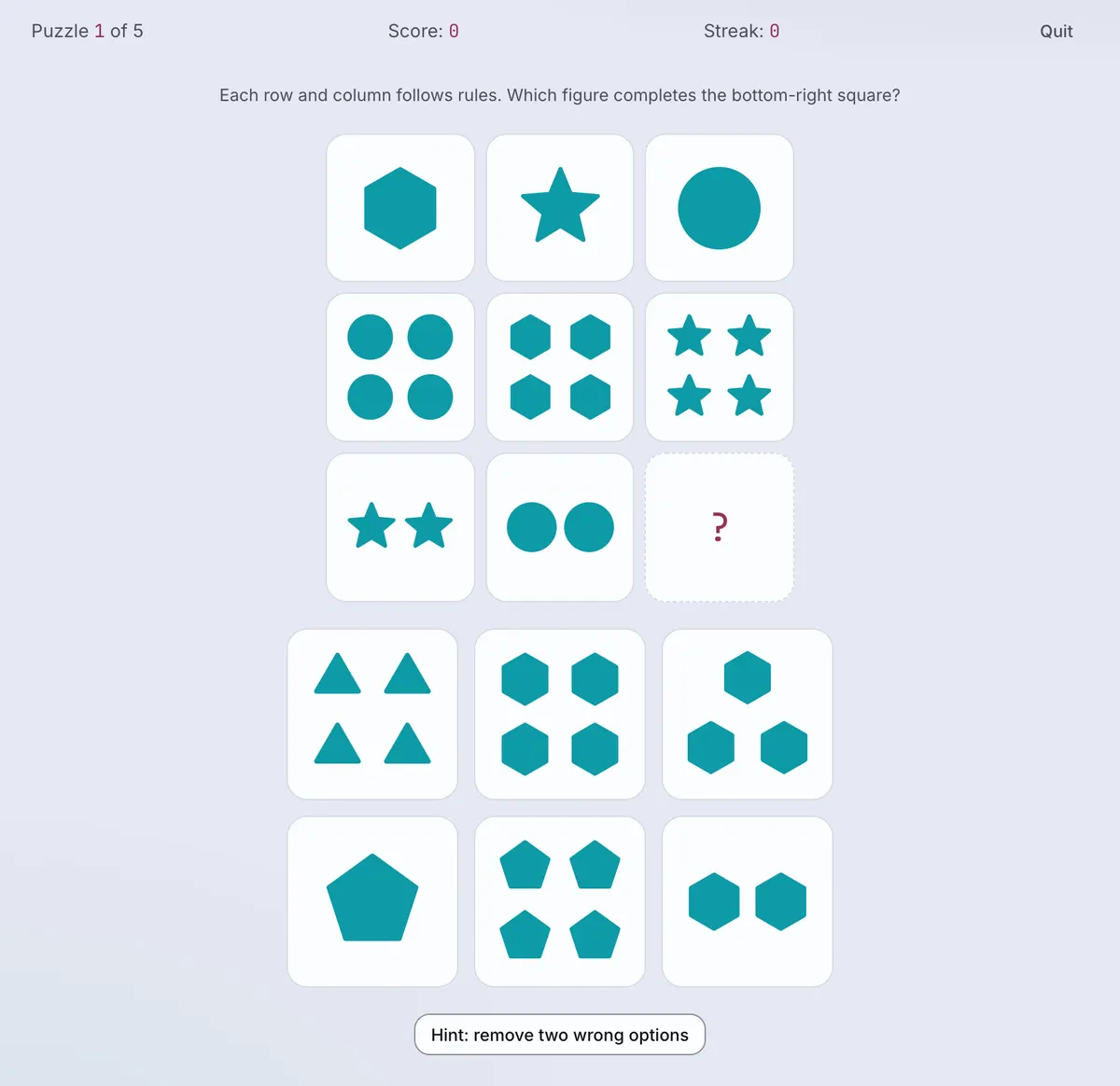
A matrix puzzle shows you a 3×3 grid of pictures with the last one missing, and asks which of several options completes it. They look intimidating the first time: shapes, numbers, sizes, shading and colours all changing at once. The good news is that almost every matrix puzzle gives way to one simple habit.
Look at one property at a time.
This post explains what that means in practice, the handful of rules that come up again and again, and the mistakes that catch most people out.
Why these puzzles feel hard
Your eye takes in the whole grid at once and tries to find "the pattern". But there usually isn't one pattern. There are several, each controlling a different property of the figures, layered on top of each other. Trying to see them all together is like trying to read five overlapping sentences.
Pull them apart and each one is usually simple.
The method, step by step
- List the properties. Before you hunt for rules, name what can change. In most puzzles it's some of these: the shape, how many shapes there are, their size, their fill (solid, outlined, striped) and their colour. Some puzzles add position or rotation.
- Take the first property and ignore everything else. Say you start with the number of shapes. Read across the top row: 1, 2, 3. Then the middle row: 2, 3, 4. Now you have a rule, and you can predict the missing cell.
- Repeat for every property. Shape, then size, then fill, then colour. Each gives you one fact about the missing figure.
- Build the answer in your head first. Combine the facts: "three small striped triangles, blue". Only now look at the options.
- Check each option against every rule. The right one fits all of them.
The rules that come up most
Once you've done a few dozen, you'll notice the same few rules repeating. A property usually does one of these things:
- Stays the same everywhere, or across a row.
- Depends on the row or the column. For example, every figure in the second column is large.
- Steps up or down by a fixed amount: 1, 2, 3 shapes, or small, medium, large.
- Uses each value once per row and column, like a mini Sudoku: each row has one circle, one square and one triangle, in different orders.
- Adds or subtracts across a row. This one is mostly about counts: the third cell holds the first plus the second.
Why the wrong answers are so convincing
Good matrix puzzles are built so that the wrong options are near misses. Each one is usually correct on most properties and wrong on just one or two. That's deliberate: it means you can't find the answer by vague resemblance. You have to check.
Two habits protect you:
- Predict before you look. If you scan the options first, your eye picks the one that "feels" right and then your brain justifies it. Decide what the answer must be, then find it.
- Check every property, every time. The option that's right on shape, count and size but the wrong colour is the classic trap.
When you're stuck
If you can't find a rule for a property, try reading down the columns instead of across the rows. Some puzzles are built column-wise. If that fails, look at the diagonals. And if a property seems random, check whether it's linked to another one: in harder puzzles, the number of shapes might equal the size, or the colour might depend on the shape.
On a timed test, don't let one puzzle eat your clock. Make your best prediction, choose, and move on. There's no penalty for a wrong answer, but there is a cost to leaving the next three questions unanswered.
Practising well
Speed comes from recognising the common rules quickly, and that comes from volume. Two places to practise:
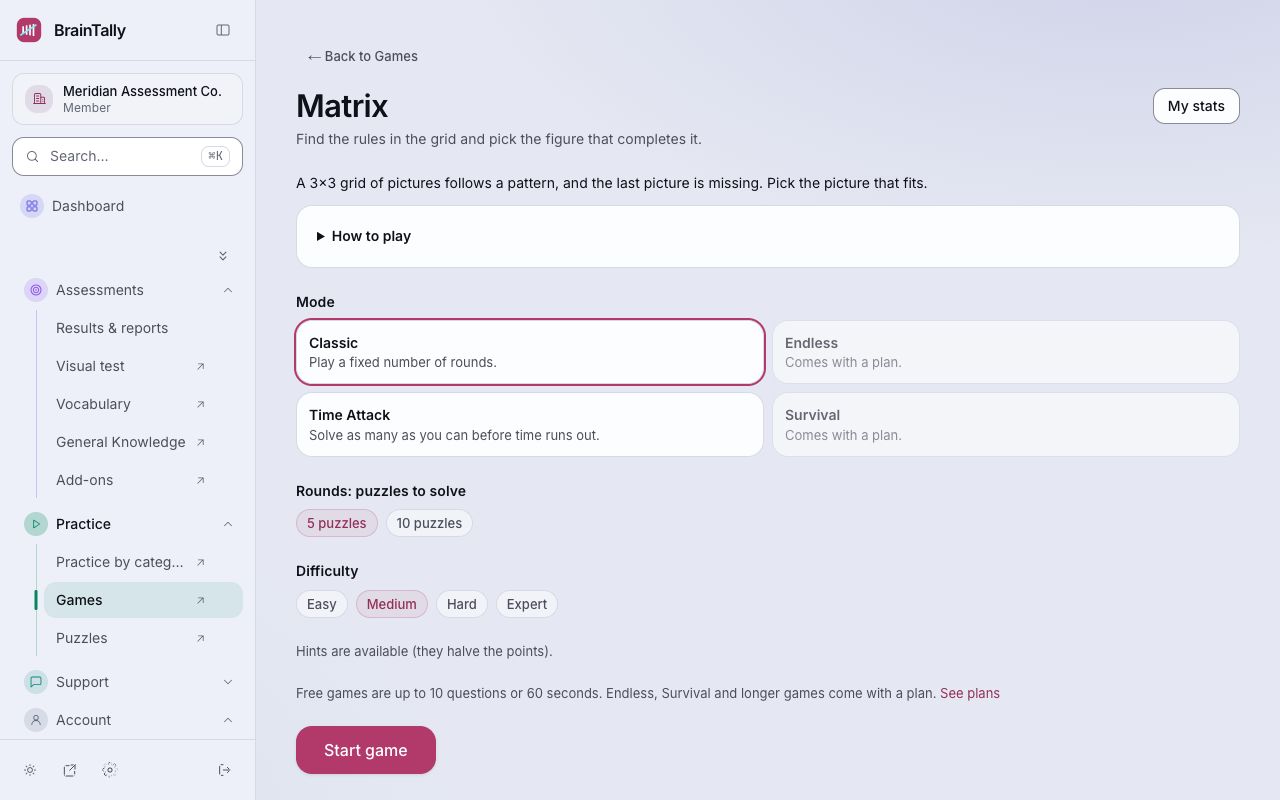
- The Matrix game, where the explanation after every answer lists each rule and shows exactly where a wrong choice breaks the pattern. On Expert, every puzzle has a 90-second countdown, which is good training for test conditions.
- The visual reasoning test and its practice categories, which use pictures instead of words and numbers.
One property at a time. It sounds almost too simple, but it's the difference between staring at a grid and solving it.