Why we bring your mistakes back
Recognising something isn't the same as remembering it. How retrieval practice works, and how BrainTally's general knowledge and vocabulary rounds use it.
There's a reason re-reading your notes the night before an exam feels productive and then disappears a week later. Recognising something is not the same as being able to recall it. The most reliable way to make knowledge stick is less comfortable: try to remember it, get some of it wrong, and come back to the parts you missed.
That idea shapes how BrainTally's general knowledge and vocabulary rounds work. Here's the thinking behind it, and how to use it.
Two well-tested ideas
Forgetting is fast, and predictable. In the 1880s the psychologist Hermann Ebbinghaus tested his own memory of nonsense syllables and found that most of what he learned faded within days, quickly at first and then more slowly. His "forgetting curve" has been reproduced many times since. The practical lesson isn't that memory is weak. It's that one exposure is rarely enough.
Testing yourself beats re-reading. Studies of "retrieval practice", including well-known work by Henry Roediger and Jeffrey Karpicke in the mid-2000s, found that students who practised recalling material remembered much more of it days later than students who spent the same time re-studying it. The effort of pulling an answer out of memory is part of what strengthens it.
Put those together and you get a simple recipe: quiz yourself, notice what you got wrong, and meet those items again later.
How BrainTally applies it
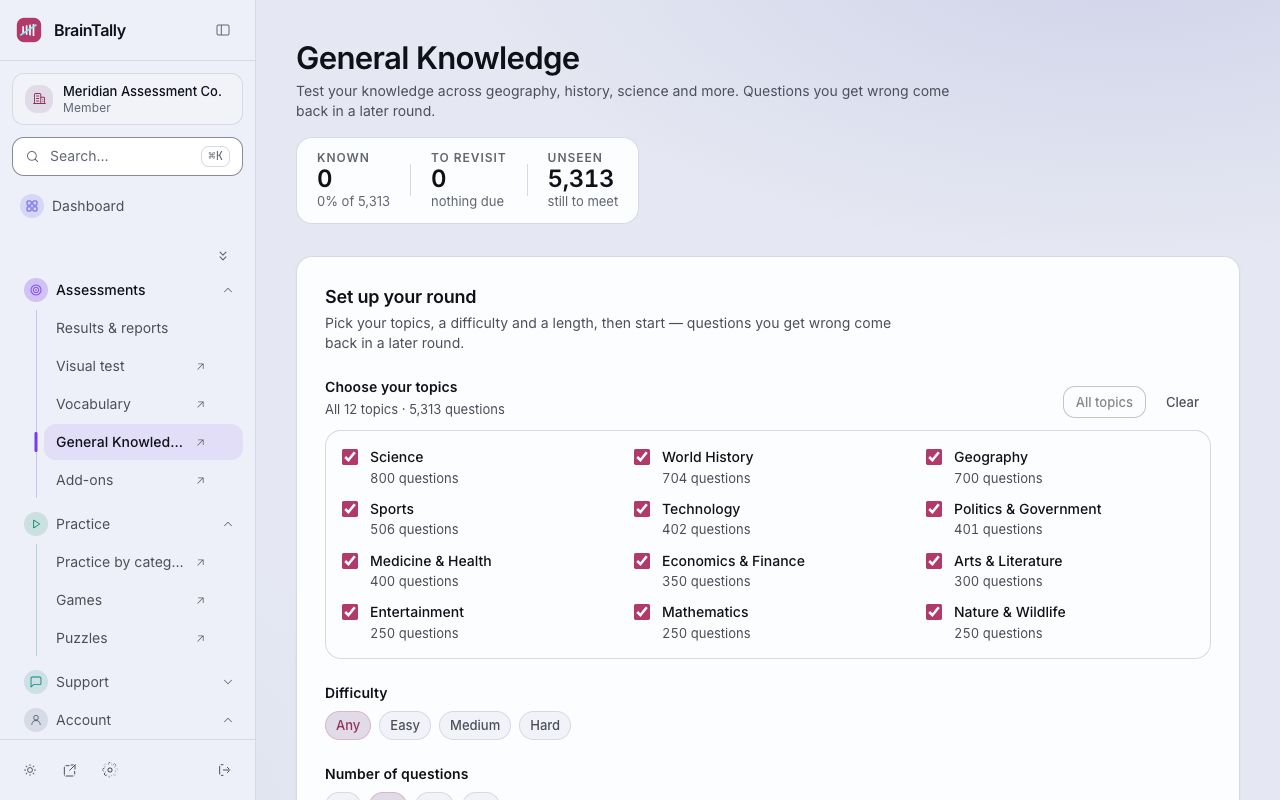
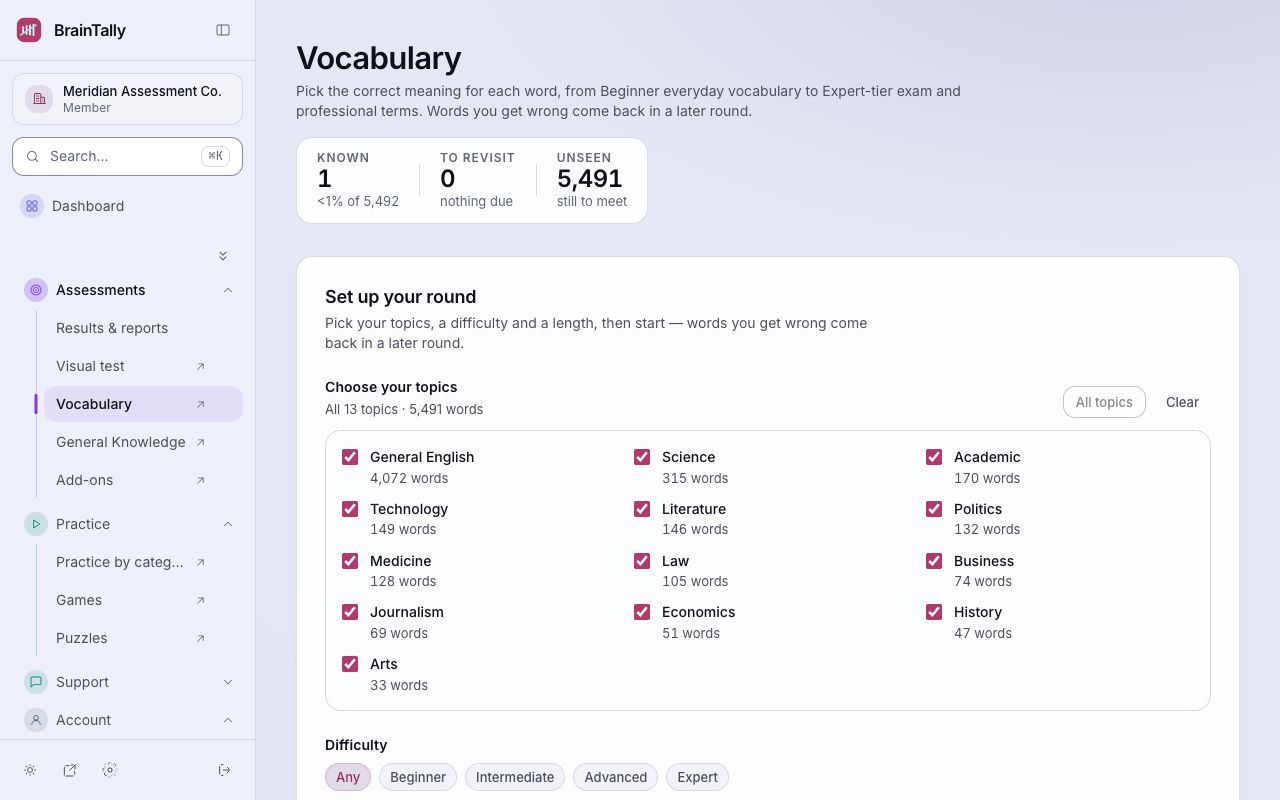
General knowledge and vocabulary are played in short rounds. Every question you answer is remembered, and your progress is split three ways:
- Known: you got it right.
- To revisit: you got it wrong, and it's due to come back.
- Unseen: you haven't met it yet.
The questions you miss don't vanish. They return in a later round until you know them. At the end of each round you also get a short list of the questions worth another look.
How to get the most from it
Short and often beats long and rare
Ten questions a day for a week will do more than seventy in one sitting. Short rounds bring your misses back while they're still half-remembered, which is exactly when recalling them does the most good.
Let yourself get things wrong
A round where you score 100% feels great and teaches you almost nothing. If you're getting everything right, move to a harder level or a topic you know less well. The "To revisit" pile is where the learning happens.
Say the answer before you look at the options
With multiple choice, it's tempting to scan the options and pick the familiar one. Try to recall the answer first, even roughly. Then check the options. That small extra effort turns a recognition exercise into a recall exercise.
Read the explanation on a miss
When you get one wrong, take five seconds with the correct answer. Ask yourself why it's right. Connecting a fact to something you already know makes it far easier to find again.
The same idea, everywhere
You don't need an app to use this. Learning a language, studying for an exam, or remembering names at a new job all work better with the same loop: test yourself, keep track of what you missed, come back to it. BrainTally simply does the bookkeeping for you, so the only thing you have to do is show up for a few minutes.
Your free account includes questions in every general knowledge topic and words in every vocabulary topic, so you can try the loop for a week and see what sticks.