What brain games can (and can't) do for you
We make brain games, so here's the honest version: what the research says about brain training, what games are genuinely good for, and how to choose them on purpose.
We make brain games, so you might expect this post to tell you they'll make you smarter. We'd rather tell you the truth, because the truth is still a good reason to play.
What the research says
"Brain training" was a booming industry in the early 2010s, with bold claims about raising intelligence and protecting memory. Scientists looked closely. In 2014 a group of around seventy researchers signed an open statement, organised through the Stanford Center on Longevity, warning that the marketing ran well ahead of the evidence. In 2016 a large review in the journal Psychological Science in the Public Interest examined the studies that brain-training companies themselves cited.
The broad conclusion has held up since:
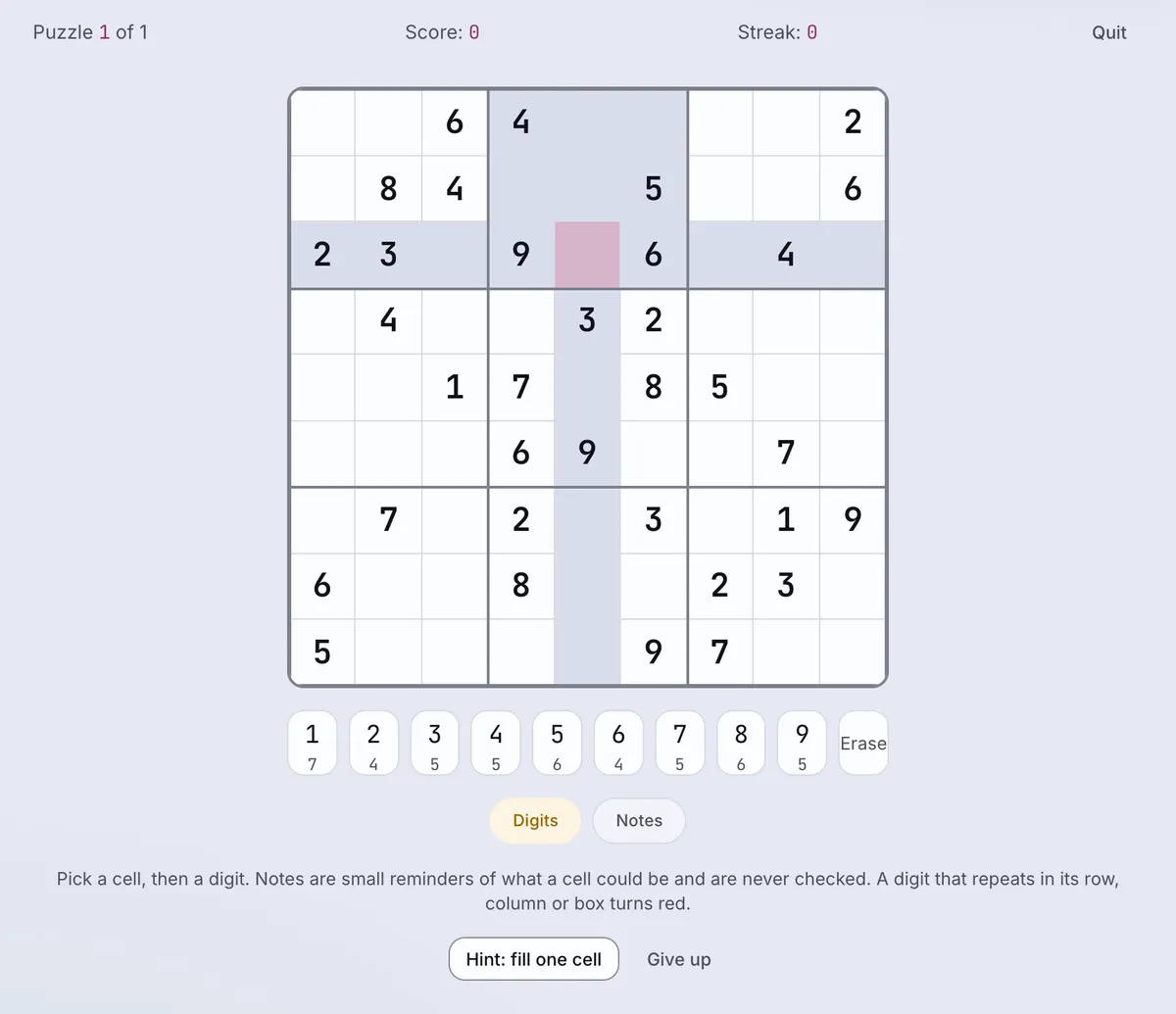
- You get better at what you practise. This part is solid. Play a lot of Sudoku and you become faster and more accurate at Sudoku.
- Closely related skills can improve too. Practise matrix puzzles and you get better at matrix-style questions in general.
- Broad "far transfer" is weak. There's little good evidence that playing puzzle games raises general intelligence, or makes you better at unrelated everyday tasks.
So we won't promise that ten minutes of Mines a day will make you a sharper negotiator. It won't, as far as anyone can show.
So why play?
Because the things games are genuinely good at are worth having.
They're good practice for the kinds of question you'll meet
Reasoning tests use a small number of question styles: sequences, matrices, logic, spatial puzzles. Games built from the same ingredients make those styles familiar. Familiarity is a real advantage on a timed test: less time decoding the question, more time solving it.
They're a good way to learn things
Geography and word games aren't pretending to train abstract intelligence. They teach you capitals, flags and words, and the short rounds bring your mistakes back until you know them.
They're a better break than scrolling
Five minutes on a logic puzzle asks something of you. It's absorbing, it ends, and you know whether you solved it. Compared with most of what fills spare minutes on a phone, that's a decent trade.
They're enjoyable
This matters more than it sounds. The habit that sticks is the one you like.
How to choose games on purpose
If you have a reasoning test in mind, look at your results first and practise where you're weakest. Roughly:
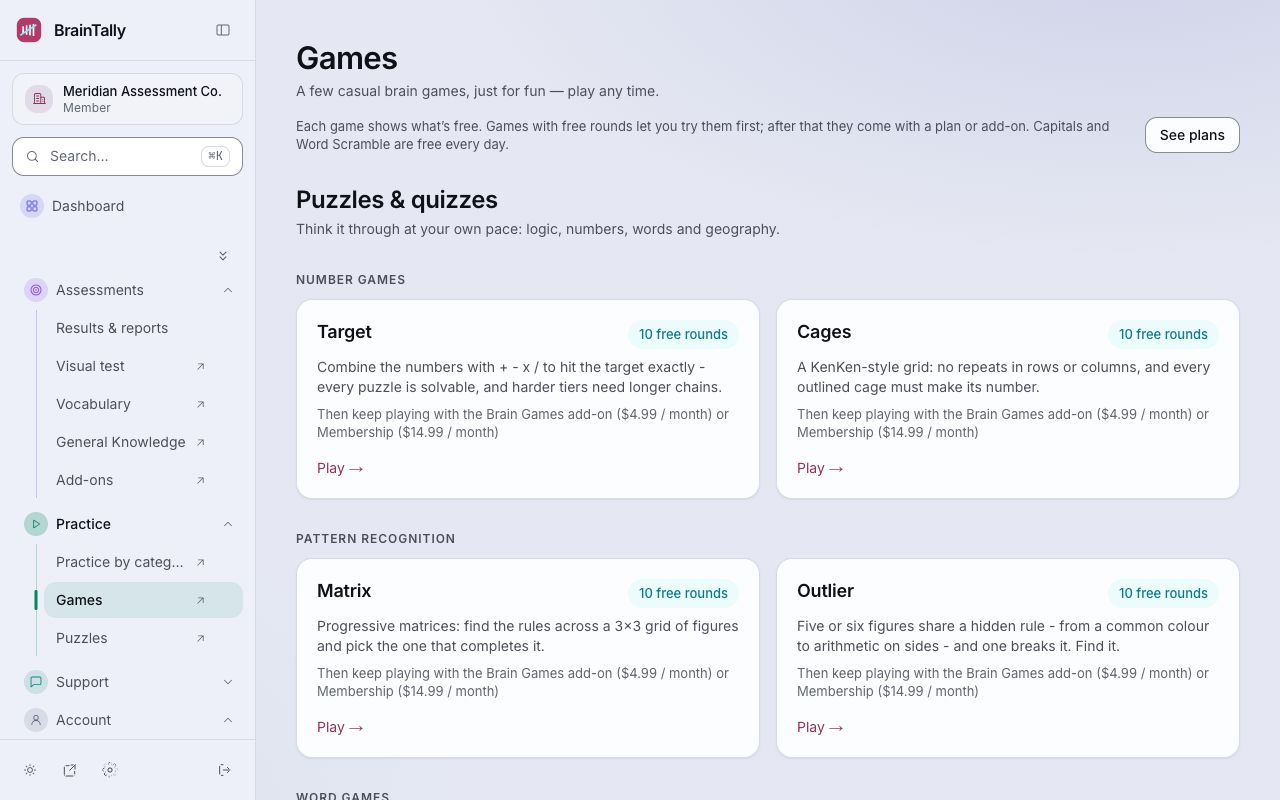
- Numerical reasoning: Number Sequence, Target, Cages.
- Logical reasoning: Deduce, Syllogism, Code Breaker, Binary.
- Pattern and visual reasoning: Matrix, Outlier, Nonogram.
- Planning and spatial thinking: Gridlock, Slide, Lights Out.
- Memory: Memory Match and the arcade games such as Tone Recall.
- Words: Word Scramble, Hangman, Spellify.
- Knowledge: Capitals and Flags.
How to practise well
- Read the explanation when you miss. Most BrainTally puzzles explain the answer afterwards. That's where most of the learning happens.
- Raise the difficulty when it gets easy. Easy and Medium give hints; Hard and Expert take them away and add time pressure. If you're winning every round, you've stopped learning.
- Try Time Attack before a test. It's the closest thing to test conditions: as many as you can before the clock runs out.
- Keep sessions short. A few rounds a day beats a long weekend session.
The honest pitch
Play because you enjoy it, because it makes the question types on a reasoning test feel familiar, and because it's a better way to spend five minutes than most. Don't play because someone promised it would raise your IQ. Nobody can honestly promise that.
A free account includes free rounds of every game, and two games are free every day.